

Futures Trees, Constructicons, and Building the Best House Ever

Aloha kākou,
It’s Aloha Friday, folks! And we are still at it – kicking and (internally) screaming our way to the end of another week! But this time, we get to listen to Christmas music, wonder what a K-Pop Demon Hunters Christmas album would sound like, and try to remember that the Christmas cards have to get mailed soon and the last of the gifts need to get ordered real soon. Because at least one order from November already looks lost in the mail… oh, dear USPS, will you ever fully recover from the 1-2 combo that was FedEx and Amazon?
But enough about the Federal government… unless you want more? I suppose we could hit a few more juicy yet enervating morsels, but understand I was only there for the first one; I left the room after that and have no direct knowledge of what took place from that point forward.
In any event, a Federal shenanigans recap is not really what you came here for. You’re here for knowledge, peeps. Insight. Foresight. Answers about the future before your competitors figure it out. Unfortunately, my crystal ball-encased Bropilot is producing jibberish this morning (although it thanks me for calling it out for not executing my instructions before going right back to acting like it doesn’t remember the first string of instructions I gave it). Instead, how about another tool/technique to help you help your team map the emerging landscape of the future.
Lots of Change, Too Much to Understand
So, it should go without saying at this point that we are living through an era of multiple, civilizational transitions. There is, put simply, a ton of change going on; there are metric tons worth of operating assumptions that are being stressed, tortured, and in rent into pieces. If you’re Gen X like me (the best generation), then you could probably spend most of today just brainstorming the assumptions about how the world works and what will get you lauded that have been tossed to the wayside in the world’s headlong rush into the roiling, mythical Nothing that the future currently represents for many good folk.
Space travel. Synthetic biology. A new international order. Climate crisis (or not). Energy transitions (or not). Robots taking jobs (or driving new ones). Regulatory loosening (long-term or just temporary?). New battery technologies, digital twins of everything, new generational preferences, tri-fold Samsung phones, and oh. So. Much. More.
There is so much going on in the world today. So much of potential societal consequence. And so much complexity. Too much. And so much of it changes so fast, or at least is reported on in breathless, hyperbolic headlines in a blurry, never ending stream of information feeds.
None of us can hope to become an expert in anything but the tiniest sliver of what’s going on in the world today (“solutions” like Anthropic’s Claude, notwithstanding). And that means that we don’t really understand most of what is below the surface in any of these topics (and keep in mind, what you are seeing at that surface level is highly curated via the platforms and algorithms you interact with).
So, what are we all doing about this? How are we dealing with the deluge and overload?
Most of us are looking for experts to follow. Folks to glean insight from. Someone to cut through the noise and tell us how to think about an issue and what to anticipate for its future.
But here’s the kicker: for most of these sprawling, complex, fast-evolving topics, the experts themselves are, of course, arguing over what’s really going on and where things are going. The stakes with many of these topics are high, and the debates are intense and consequential. Few more so, than AI.
No Oxygen, No…fire?
The single topic that is probably sucking the most oxygen out of the most leadership conference rooms right now is AI. As you of course know, AI is huge right now, like HUGE. It’s literally driving companies to have greater valuations than entire first world national economies. And driving a reconfiguration of the energy landscape. And driving nuclear power right back to the center of conversations. Who knew, right?
AI is huge, and it’s also hugely debated. The experts we all are trying to listen to are divided on what AI means, what it is really capable of, and what it means for the future. The current technologies are phenomenal. Or they’re 21st century vaporware. They are literal, existential threats to humanity. Or they’re trivial applications that will soon take their proper place along the hype cycle. They will transform the economy and free humans to live like rich, ancient Greeks. Or the bubble will pop and a new AI “winter” will settle in.
Who knows? Do you? I certainly don’t.
Fortunately for me (and I suppose, by extension, you, since you have the great fortune of knowing me 😆), I don’t have to know. In fact, in case we needed reminding, the future doesn’t exist. No one – and I em dash mean, no one – knows what the future will actually bring. And for that reason, the role of someone like me is not to attempt to tell anyone what will happen before it happens, but to map more of the emerging landscape of the future – to identify more of what is logically possible so that you and everyone else on your team is better sensitized to the signals of change, better informed about the potential threats and opportunities, and better prepared for the emergent contingencies.
And so, without further gilding the lily on this snow-covered winter morn, let’s speed you along to a tool that will help you (help your team) with mapping out more of what is possible when it comes to the future of (generative) AI.
O Futures Tree
You know, there’s got to be a name for this (it’s not “decision tree”), but for the life of me, I couldn’t recall what it is. I even asked other smart people, who also couldn’t recall. And so, because apparently an advance party of alien scouts running ahead of 3I/ATLAS’s arrival has curiously wiped our memories of this technique’s formal name, I’m simply going to call it a futures tree. And in this case, it’s our AI Futures Tree. Behold:
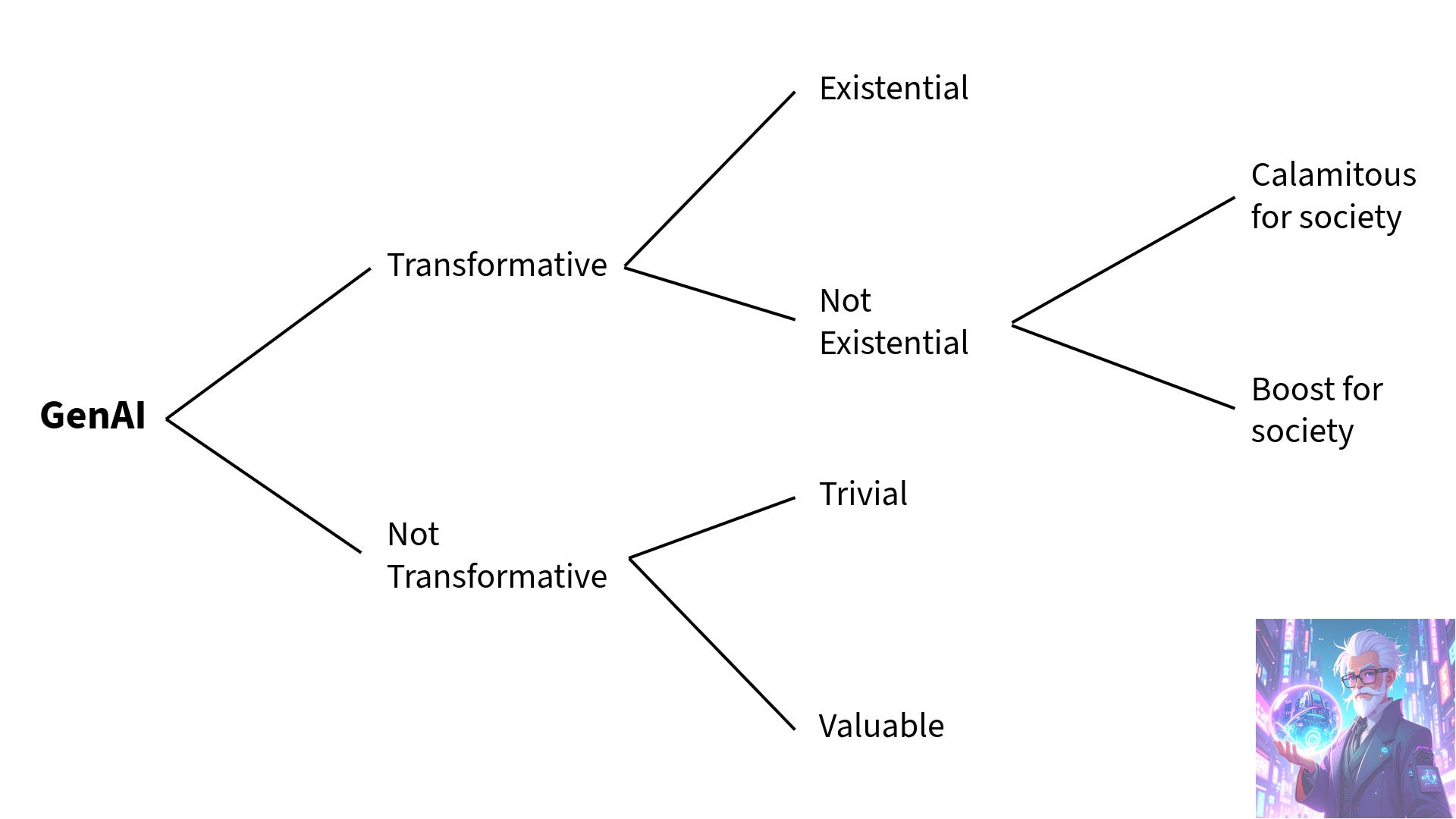
OK, so all I’ve really done here is to map out the logical alternative outcomes, based on the various debates, discussions, and declarations you hear about generative AI and what it means for the future. I’m just mapping the logical alternatives.
I don’t know which of these endstates will obtain in the future, and right now, I don’t have to. This is not a prediction tool, or even a deeply analytic tool. It’s a visualization tool to help me (and others) map out all the logical possible outcomes, based on the key uncertainties we’ve identified.
Why is that useful? First, it’s about gaining clarity. Right now, if you threw your leadership team into a room to quickly discuss the future of AI, the convo would probably veer all over the place. Different levels of genuine knowledge, disciples of different “experts,” and different images of what the future holds. A tool like this helps all of us figure out where we are and it then helps us compare how each of us got to where we are on the topic. A more rational conversation.
Second, once we have all that mapped, we can then actually conduct more focused research to learn more and perhaps reevaluate our assumptions and beliefs on the topic. Especially as a group, we’re better positioned to research and further debate the state (and future) of things.
Finally, once we’ve mapped all of this, then we can start to talk about early indicators, preparing for different scenarios, and even, should you be so inclined, to mess around with stuff like assigning probabilities to the different branches of the tree.
And it doesn’t take long to roll this out. 20 minutes for any topic will springboard you to a better discussion. And for GenAI, I’ve already done the initial heavy lifting!
So, pass this around today, have people circle the outcome they currently believe in, then assemble the Avengers in the conference room next week to have a slightly more strategic discussion about the future of AI – in your business, and in our world.
Today’s Round Up of Scanning Hits
MIT researchers “speak objects into existence” using AI and robotics
Woot! Let’s start this off strong. High tech, robots, and literally commanding the future into existence. “Speech-to-reality” is, incidentally, the belief system with which my children were born, clearly believing that just by demanding things, their parents (and the rest of the universe) will hop to and oblige. And you know what, two days ago my son kept stating that the school district should declare a snow day and, you know what? They hella did! Now, if only they could “manifest” a clean bedroom… but then again, maybe I just need some of these robots scuttling around my house. Besides, the Roomba might actually be lonely…
Chatbots Are Surprisingly Effective at Swaying Voters
Speaking of AI, here are, apparently, all your secret machine-manipulation fears realized. So, someone actually ran a study last year before the presidential election, to see how much a chatbot could influence voter inclinations. Well, according to the study, the answer is quite a bit. And the effect apparently was lasting. So… now that this cat is out of the bag (with data), where else should we expect this revelation to get applied? In what seemingly innocuous context should we now expect to see little AI chatbots popping up just to have “helpful” convos with us about, say, which insurance company to go with, or why spending on “wellness” products is better than exercise. Where, o where, will we see this next? Psst: confidentially, where would you embed this?
Kalshi CEO Says He Wants to Monetize ‘Any Difference in Opinion’
Speaking of business models, how about prediction markets. Or, more sarcastically, monetizing differences in opinion. According to the article, the CEO of this prediction market wants to “’financialize everything and create a tradable asset out of any difference in opinion.’” I’m not even sure I fully understand what that means. When prediction markets first emerged years and years ago, they were fun, and then later kinda cool, I suppose. But I’ve never been taken enough with them to put much stock in it (yuck, yuck).
Tomorrow’s Headlines, Today (sort of)
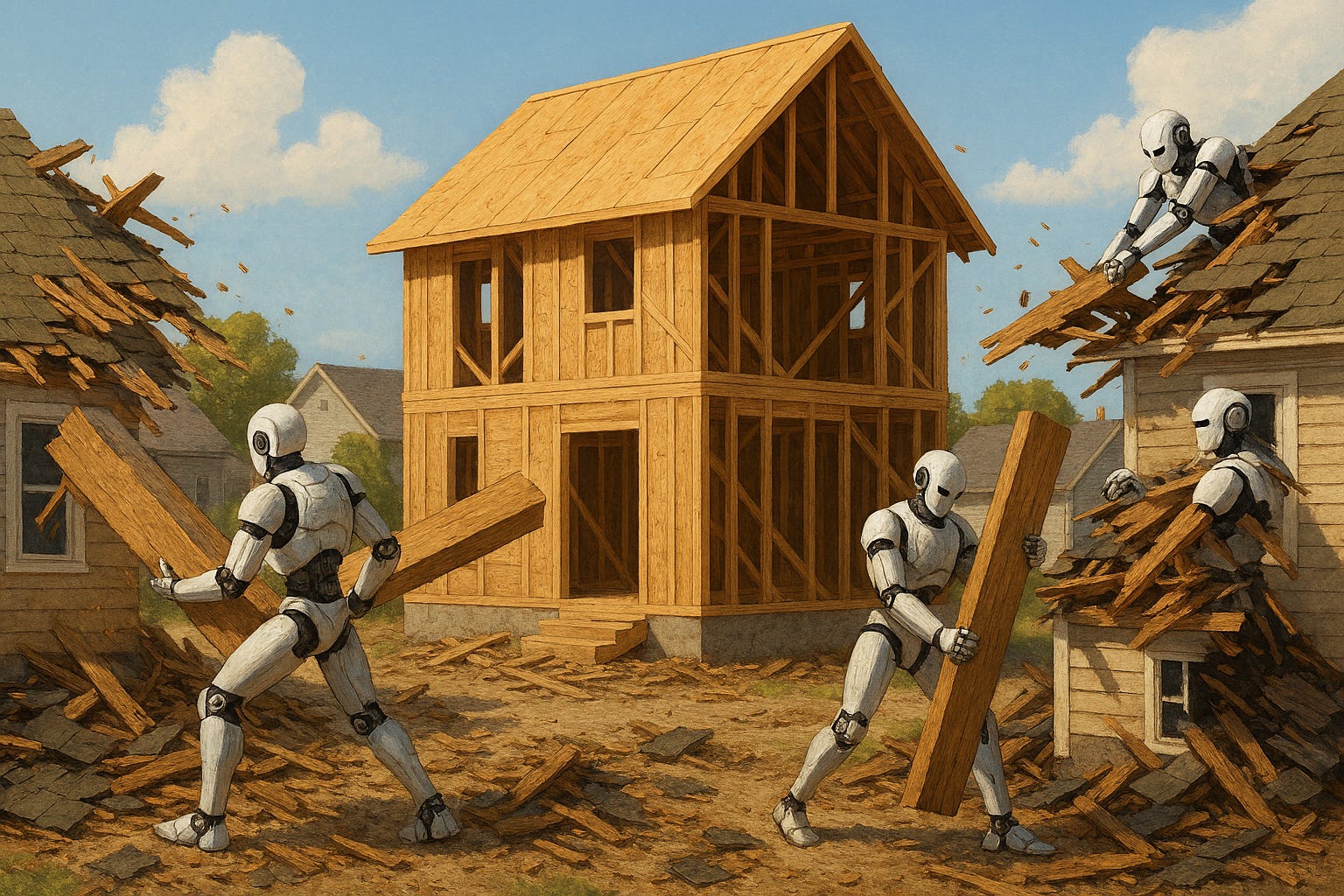
“Habitat for Humanity’s New ‘Speech-to-House’ Team of Robots Unexpectedly Deconstructs Neighborhood to Construct ‘Best House Ever’ Wish Made by Child. Local Neighbors Not Amused as ‘Autonomous Deconstruction’ Not Covered by Home Owners’ Policies.”
Complexity and unintended consequences, folks. And yes, I’m still reading If Anyone Builds It, Everyone Dies.
That’s it for this week!
As always, reach out to us about diving into these and other issues in more depth with your team.
And for those interested in running wargame sessions with their teams on either global trade war scenarios or US workforce scenarios, hit us up!
Playbooks! Check out our two most recent DIY foresight kits.
Richard Kaipo Lum